
Saturday, May 11, 2013

A SPRING FLING - A CAMPARI AND VODKA COCKTAIL

What can I get you?

He leans across the bar.  Kindly looking into my bewildered eyes.  A simple question he has asked numerous times this evening.  He expects a simple and quick reply.

It's 6:30pm on a week night and the place is already buzzing with after-work imbibing.  Hipsters and the like winding down the day - or maybe just getting started for the night.  It's loud, the energy of the place palpable.  It's a familiar scene from what feels like a distant past.  Before set routines, before children.  A time when meeting up for drinks at 6:30 pm didn't require extensive planning.  

Can I get you something to drink?

I look back at him, stunned.  I've lost the ability to order a drink for myself.  The vibrant energy of the place doesn't match my scattered focus.  I can't settle in.  I've spent the day picking up, dropping off, deciding what to make for lunch and breakfast and then making lunch and breakfast simultaneously, driving the lengths of Los Angeles freeways, cursing said freeways, worrying about being late for pick ups and drop offs,  deciding what's for dinner for the six and under crowd, barely making it here...  I'm at a loss for words as to what I could possibly want to drink.  I cannot make another decision.

She'll have a Campari and soda.

That's it.  That's what I wantHe knows.  This man with the warm and reassuring voice seated next to me.  He knows exactly what I want.

But why don't we change it up a little.  Do you have any suggestions for a Campari cocktail?

And so they begin to conspire. These two men.  One a complete stranger - the bartender.  The other - my husband. They discuss my likes and dislikes, and they come up with a drink that would both satisfy and surprise my taste buds.  No decision-making on my part. Finally. 

We were on our way to join some friends at an event.  On a whim we decided to meet up just the two of us for a quick drink beforehand.  We hardly do anything on a whim anymore.  It felt adventurous, secretive.  A stolen moment.  


I'm not much of a drinker.  These days my preferred beverage of choice is often something that will energize, refresh, and see me through the day.  (A smoothie, my green tea, my black tea, simple and oh so enjoyable water, perhaps a spot of my husband's lastest project of the month, kombucha.)  Alcohol often has the exact opposite effect on me.  But I do enjoy that one glass of something every now and then. Anything over one glass, and fatigue, headache and general irritability quickly set in.  So that one glass has to be a drink I thoroughly enjoy.  The glass of red wine - dry, aged and  full-bodied - to accompany dinner, that first and unmatched thirst quenching glass of beer enjoyed on a hot summer's day,  the perfect martini - dirty with extra olives please - shared with friends; and my all time beloved aperitif - campari. I like my cocktails sour, a little bitter with a slight hint of sweet.  And this campari cocktail satisfies all these requirements.


He carefully places the pink concoction in front of me.  It's the color of those LA sunsets we marvel at every now and again.  Other-worldly, surreal, a magical light I can only associate to this expansive city of ours. 

I feel both mens' gazes intensely watching me as I take my first sip.  Conspirators - the stranger and my life partner.  

It's perfect.  I say.  Great, enjoy, says the bartender, and he casually moves on to tend to the needs (anxieties?) of others.  I turn to Drew and just like that I feel myself giving in.  My body shifts, I lean one arm on the bar, chin resting on hand,  the weight of the day is transformed and absorbed by the cool marble bar top.  I settle into the gaze of my husband, our conversation (mostly about the girls), this stolen moment, our little spring fling. 

Happy Mother's Day.


Sunday, May 5, 2013

A SPRING FAVA BEAN, DILL AND EGG STEW - BAGHALI GHATOGH


The salty air.  The very salty sea.  A warm seaside breeze.  Hair tangled and knotted in the wind - sticking to very salty lips. 

These are my memories of Shomal - North.

Memories can be very elusive, hard to pin down.  They tease us with a hazy snap shot of what once was - a time long since passedA familiar scent, taste, the caress of a warm breeze.  Sometimes that's all it takes to get wrapped up in the all-consuming embrace of nostalgia.

The Northern region of Iran bordering the Caspian sea is referred to as Shomal.  It is made up of three seaside provinces: Gilan, Mazandaran and Golestan.   

My father's family hails from Gilan, a region well known for its rice paddies, lush green Alborz mountains, popular seaside destinations (for tourists and locals alike), its very distinct Gilaki dialect, and of course its cuisine.  Volumes could be written about the delicious food of Gilan -  khoresh fesenjan (pomegranate and walnut stew - a dish  particularly close to my heart), mirza ghasemi, kabab torsh, zeitoon parvardeh...and of course the abundance of fresh seafood and its much prized caviar.  But the one dish enjoyed most often is baghali ghatogh.

Baghala ghatogh (as it's called in Gilaki) is traditionally made with a type of bean called pacha baghala - which literally translates to short-leg beans.  

I was inspired to try my hand at baghali ghatogh after spotting the abundance of fresh fava beans popping up at the farmers market.  Fava beans (fresh or frozen) or lima beans (fresh or frozen) are often used as a substitute for pacha baghala - which is not readily available outside of Iran.  After a call to my cousin for a little direction I learned that canned white kidney beans (cannellini beans) are also a good and quick substitute.  So you have a few choices for the bean - but I had my sights set on those favas.


Call it cooking serendipity, chance - what you will - it was also right around this time that Baba -  my dad - and step-mother Kumi decided to surprise us with a visit.  And after one glorious family outing to the farmers market I had Baba making his baghali ghatogh.  Fresh fava beans, fresh spring garlic, fresh dill, and eggs.  The makings of a perfect springtime meal.

This dish is very quick and easy to prepare.  Except for one thing - shelling and peeling the fresh fava beans.  I won't sugarcoat this.  It takes some time - as in, it took 45 minutes to get through it.  And like you,  I really don't have an extra 45 minutes to devote to shelling 4lbs of fava beans.  But I do it because fresh favas are here for a short period of time and they taste great - because of the ritual - the tradition - beacause I imagine my aunts, uncles and cousins having done the same.  And yes, also because I'm inclined to get obsessive like that.  To make it a little less time-consuming you can split up the bean shelling and peeling process.  You can shell the beans the night before while you catch up on your favorite tv show.  Then store the shelled beans in a plastic bag in the fridge.  All you have to do the next day is peel the outer skin.  Try not to split the bean in half when you do this.  Once the outer skin has been peeled you have to cook the beans right away.  Or even better, enlist the help of others. (Please note fava beans can cause a rare but serious allergic reaction in some people and children.  Make sure you or your little ones are not allergic before handling or eating favas.)

The afternoon we got back from the farmers market with our 4lb bag of favas quickly turned from a we'll just make a simple baghali ghatogh dinner to an epic food odyssey.  As it often does.  Seduced and inspired by the goods at the farmers market, we decided last minute to throw together a fresh herb koo koo (Kumi's request), steam some artichokes (the girls' absolute favorite), put some rice on and quickly saute some fish (the way Baba likes his baghali ghatogh served).  As for Drew he had no requests - he just loves and consumes it all, in high quantities.  


Baghali ghatogh is typically served over rice, with a side of smoked fish.  Or that caviar from Gilan - if you can get your hands on some... I also like it served over some crusty bread to soak up all the delicious juices with some salty feta cheese (to mimic the salty smoked fish) crumbled on top. 


Every corner of the house was alive with activity.  Baba shelling and peeling the favas at the coffee table - Soleil perched in front of him watching attentively.  Kumi prepping the herbs for the koo koo at the kitchen table - Luna working on homework and munching on watermelon.  Me at the kitchen island - command central - wondering exactly how we got ourselves into this madness.  Every pot in use, both oven and stove in play, the background music trying to keep up with our tempo, children's questions, costume changes (impromptu fairy performance!) and other needs being met.  Absolute wonderful chaos.  And somehow, as is usually the case, it all came together.  All of us gathered around that kitchen table digging into some baghali ghatogh
 
 
I was about Soleil's age the last time we were in Shomal.  And now, all I have to recall from my visits are those hazy snapshots - the salty air, the salty sea, the warm breeze. 

I wonder if many years from now the girls will all of a sudden get a flash, a snapshot of a bustling and loud kitchen filled with the aroma of fresh dill and parsley, homework with a side of watermelon, aged but still strong and gentle hands of a grandfather shelling fava beans... 

Sunday, April 28, 2013

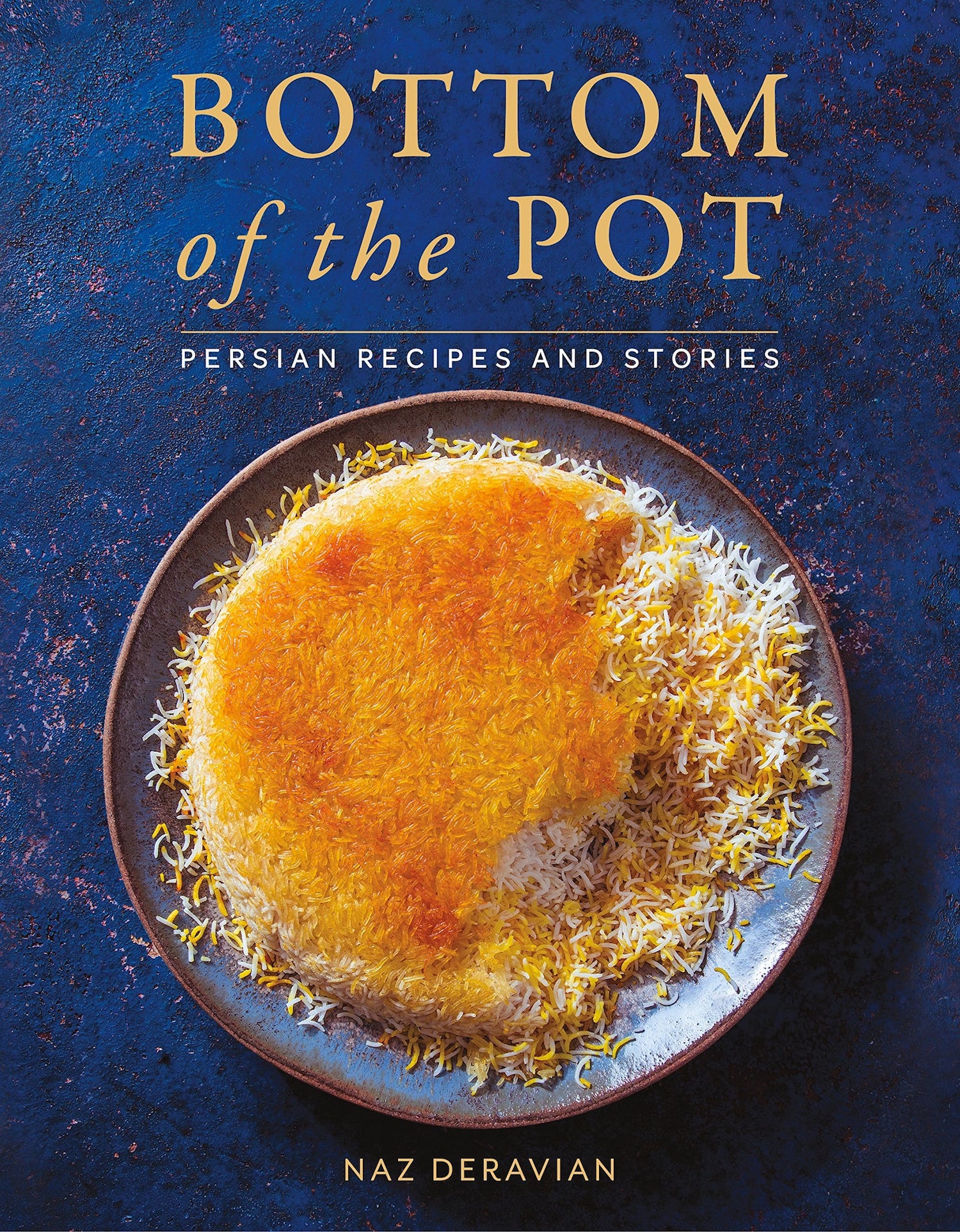
RICE AND THE ART OF GETTING TO THE BOTTOM OF THE POT - CHELO BA TAHDIG


They gather around me with bated breath.  The air is thick with anticipation and hope.    

If it all goes as planned, the fruits of my labor will be met with thunderous applause and joyous cheers.  High fives and high jumps and quasi-cartwheels all around.  Maybe even a little impromptu jig. 

If it all falls apart (literally), shoulders will slump, and slight groans will replace the cheers.  Dissapointed little feet will shuffle back to the table.  And once they recover from this let-down, they will do their best to make me feel better.

It's ok Mama.  Next time.

It's not as great as usual Mama but it's still ok...

These are the pressures I face.

They crowd in even closer.  My audience of two.  I place the serving dish over the pot.  Inhale.  Hold my breath.  Tighten up my abs.  Chant a little mantra.  Flip the pot over.  

First it's the triumphant sound of success, the swish sound of the release, as the rice drops from pot to dish.  I gently pull the pot up and away and there she is in all her glory - golden and regal  - TAHDIG.  Merrymaking ensues.  Exhale.  The Muse of Cooking decided to smile upon me  - this time.


Rice is the crown jewel of Persian cuisine.  A platter of fragrant saffron-steamed rice is almost always present at the dining table.  The perfect companion to the many flavorful stews (like celery stew), koo koos and kababs.  As a child there was nothing more comforting and reassuring as a bowl of polo* ( cooked rice), crunchy tahdig, with 
mast o khiar and a few sprigs of fresh mint and parsley.  

* Technically, plain saffron-steamed rice served alongside a stew is called chelo-khoreshPolo is steamed rice mixed with other ingredients like vegetables and meats.  But in our house we refer to all cooked rice as polo.   

A Persian cook's reputation rests first and foremost on his or her ability to turn out the perfect pot of fluffy rice and tahdig (pronounced "tah DEEG").  Tahdig literally means the bottom of the pot The most common type of tahdig is made with rice (using bread or potatoes is popular as well).  The crispy, golden fried rice, nestled at the bottom of the pot - and the most coveted dish at the table.  

Making Persian rice is truly a creative process.  No pot of rice ever turns out exactly the same and a perfect golden tahdig is never assured.  But even at it's most imperfect, it's as close as one can get to delicious perfection.  Really. 

Every grain of rice should be separate, long, individual, fluffy - and shine on its own.  No clumps.  No sticking together.  Every grain is a jewel.

These are the words that echoed in our kitchen as my mom gently, methodically and artistically scattered the steamed rice - the jewels - on a platter. 


There are a few key ingredients and techniques that you must follow to achieve this:

RICE
You have to start with a long grain rice.  Indian white basmati rice is very similar to the rice enjoyed in Iran.  On any given day if you go the Persian market you can overhear the ladies AND gentlemen passionately discussing the merits of one imported basmati brand over the other.  I use the Lal Qilla brand (which means committing to a 10lb sack).  I have also found the Trader Joe's white basmati works quite well too.   Try a couple of different brands.  You'll get a feel for which will turn out the fluffier rice.  Or visit a Persian market and ask.  But beware you might get a twenty minute thesis on rice!  We are very serious about our rice.

I should also mention that we made the switch to brown rice many years ago, for all the obvious nutritional, health conscious, waistline-minded reasons.  But there are times when nothing else will suffice but a dish of white saffron-steamed basmati rice.  

POT,  PAN AND HEAT DIFFUSER
You have to use a non-stick pot or a deep non-stick pan.  A well-seasoned cast iron works too. DO NOT USE YOUR DUTCH OVEN OR STAINLESS STEEL POTS.  To get the most tahdig, try to use a pot or pan with a flat bottom and one large enough that will give the rice plenty of room to expand.  If your pot or pan is too small the rice will clump together.  For this recipe I used a pot with a 10" bottom.  If using a pan, make sure you have a lid that will tightly fit it.  The zeery - heat diffuser - is used to ensure the tahdig doesn't burn.  If you don't have one don't worry about it.  It's just extra insurance.

HEAT SOURCE
Heat temperatures differ on any given stove.  This is where you have to get a feel for your heat source and its relation to your rice.  It's basically knowing when to go from a high heat to a low heat.  


THE TWO STEP METHOD
Here comes the art.  You will first par-boil the rice (much like making pasta) so it is al-dente.  This also comes down to a feel for knowing when it's al-dente and ready to drain.  It all depends on the quality of the rice you use and how long it has soaked.  You want the rice to be soft but still with a bite to it, not completely cooked through.  Boil it too long and you'll end up with clumpy overdone rice; boil it not long enough and your rice will be slightly hard.  

The second part is the steaming process.  There is a dichotomy at play here.  As you want to gently steam the rice up top you also want to crisp up the tahdig at the bottom of the pot without burning it.  

SERVING
There are two options on how you can serve the rice.  First, with a spatula you can gently scatter the fluffy rice onto a serving dish.  (No dumping the rice out of the pot onto a dish in one fell swoop.  Remember, you are dealing with jewels!)  And then gently loosen and remove your tahdig from the bottom of the pot, divide in portions and serve separately.  


Or, you can place a serving dish big enough to fit over the pot, and carefully but with purpose, flip the pot over.  Tahdig still intact.  Kind of like a cake.  This option has a great "tada" and "wow" appeal.


Think of Persian rice as a coy lover.  You have to treat her with respect.  You have to be patient.  You have to know when it's appropriate to make a move and when to pull back, give her space.  You have to seduce her with a gentle touch, poetry and love.  And ultimately you have to dive in with complete and utter unbridled passion and abandon.  If she turns you down the first time - try, and try, and try again.  Because she's worth it.  Really. 


Please do share and let me know how your rice and tahdig turns out.  Were you good to your lover? Was your lover good to you?

Sunday, April 7, 2013

THE BEST SOUP IN THE WHOLE WILD WORLD - LENTIL AND BARLEY SOUP


Mama, this is the best soup in the whole wild world.

Soleil is right, Mama.  Make this soup every day and every night and every afternoon. 

Can we have this for lunch tomorrow, Mama?!

Allow me to explain.

Although I'd like to take full credit for all the glowing adulation of my-soup making abilities, I  also need to extend a big thank you to my not so silent cohort - sugar.  The white, refined, not-so-natural variety.  Oh what the heck - let's give credit where credit is due.  Thank you:  corn syrup, red dye #40, blue #1, yellow# 5...

Allow me to explain further.

The girls had had a busy, fun-filled day at a kid function, and had - as expected -  indulged in kid function goodies.  Candy, baked goods, non-food food and more candy.  By the time they were back home the clock edged closer to the precarious 5:30ish hour.

The sun begins to set, their voices reach a feverish sugar-induced shrill; suddenly all goes silent - cue Ennio Morricone. 

What was once an inviting family living room is now a barren desert.  The tumbleweeds roll by in the form of half-clothed barbie dolls.  Once sisters, once compadres, forever tied in blood and love - now square off on either side of the rug.  Hands on hips, fire and determination in their eyes, ready to pounce at any moment, at any slight misspoken or misunderstood word by the other.  We have entered no man's land, no man's time...We need to reset.  We need something to make us feel whole again.


This is our go-to meal any night of the week.  Although quite hearty, we enjoy it all year round.  Barley and lentils are the stars of this soup, followed by a supporting cast of nutrient rich vegetables. Both barley and lentils boast numerous health benefits.  They are both high fiber foods which help in stabilizeing blood sugar levels.  Might explain why this soup was so needed and appreciated after a sugar filled afternoon.


Whenever possible I try and use hulled (or hulless) barley.  This means that the barley is in its whole grain form, and unlike pearled barley hasn't been stripped of its nutrients.  If you can't find hulless barley the next best options would be pot/scotch barley or semi-pearled barley.  Hulless barley is much chewier and heartier than pearled barley so I recommend that you soak the hulless barley overnight to cut down on the cooking time. Soaking the grain also helps in better digestion and absorption of the nutrients.  I also soak the lentils for the very same reasons but not as essential as soaking the barley.


Onion, garlic, celery and carrots are the main vegetables I use.  From there I add any other vegetables I have roaming around in the fridge or available in our farm box. The particular addition of  turnips, spinach, cilantro and parsley seem to work quite well with a certain six and three year old in from the cold of the wild west.  I like to add my herbs and greens right at the very end to maintain their color and fragrance.  But if you're using a heartier green like kale, I suggest you cook it a bit longer.  We like to finish off the soup with a number of different toppings.  Usually it's a drizzle of olive oil and some crunchy salt.  It is also delicious with a sprinkling of parmesan, a dollop of yogurt, or a squeeze of a lemon.

When we start to fall apart, this soup puts us back together again.  It's what grounds us when the whole world seems to have gone WILD.

Wednesday, March 27, 2013

OUR HAFT SEEN TABLE


Nowruz celebrations last for thirteen days.  During this time families and friends visit each other and homes are always ready to greet well wishers with hot tea and sweets.  It all culminates on the thirteenth day - seezdah bedar -  with a big picnic outdoors.

We have had a wonderful Nowruz surrounded by good friends and family.  Our Haft Seen table will stay up for a few more days - although the sweets and mixed nuts dishes  are quite depleted.  Little fingers always find their way to the Haft Seen table...


Tuesday, March 19, 2013

FRESH HERB KOO KOO - KOO KOO SABZI


Mmmm...what's that smell, Mama?

It's koo koo again.  Do you think you'll want to have more, Luna?

With that smell all in the house, how can I ever say no!

This was our third batch of herb koo koo in three weeks.  After days of koo koo for lunch, dinner, after-school snack; and having exhausted every cuckoo - koo koo joke, I was certain there would be no interest in yet another bite.  But once that smell takes over the house...how could we ever say no...


Koo koo is a dish somewhat similar to a quiche or a frittata. There are many different preparations for koo koo.  Fresh herb koo koo is one that is traditionally enjoyed as part of our new year - Nowruz - meal.

Nowruz is a celebration of Nature and Life.  We welcome the arrival of spring, by celebrating and honoring all that we are surrounded with.  The air that fills us with life; the fire that gives us warmth and light; the water that quenches our thirst; the flora that intoxicates us with their perfume and beauty; the fauna that reminds us that life extends beyond the human form; the eggs that represent new life and fertility; the book of poetry that lifts our spirits and fills us with hope for the future; the baked goods that sweeten our tongues and our hearts; and the green herbs and vegetables that nourish us and give us strength.


This koo koo was inspired by the overflow of greens in our farm box.  Swiss chard is not typically used in a koo koo but I thought it would work well alongside the spinach and abundance of fresh green herbs.  I also like to simply saute the rainbow-hued stems in a little olive oil, garlic, salt and fresh lemon juice, and serve it alongside the koo koo for a little added color.


As for that smell - that would be the combination of the sabzi - the fresh green herbs.  Dill, cilantro, green onion, fenugreek, tarragon and parsley.  Curly parsley.  There I said it.  I, like you, have been programmed to to turn my nose up to the unsophisticated step-sister of the much cooler and popular Italian parsley.  For years my mom and I have been arguing the "chicness" of Italian parsley (me) vs  her preferred curly parsley.

It is juuuuicier.  It is more flavorful.  It is more fragrant.
  
I am here to admit (once again) that my mother was right.  When it comes to cooking Persian food, curly parsley - is just better.  But of course, if Italian parsley is what you have at hand then use that.  That will work too.

 
We enjoy fresh herb koo koo with a side of mast-o-khiar and a salad for lunch.  It is also fantastic as a sandwich with your favorite kind of bread - a typical school lunch for the girls these past three weeks.  It also makes for a simple and nourishing dinner served with rice.  Fresh herb koo koo would also be a great vegetarian addition for an Easter brunch.  

Within the first few minutes of putting the koo koo in the oven - the kitchen fills with that smell.  The smell of spring.  A new year.  New possibilities.  Family.  Health.  Love.  Life.

Wishing you all a Happy Nowruz.